
Medicaid in Oklahoma: Understanding how SoonerCare works, who it’s for, and how it’s funded
Medicaid is a pillar of Oklahoma’s health care infrastructure: nearly one in four Oklahomans has health insurance through SoonerCare, Oklahoma’s Medicaid program.
Nationally, it is the single largest payer for behavioral health services, with nearly 20% of Medicaid enrollees living with a behavioral health diagnosis.
In Oklahoma, Medicaid is administered by the Oklahoma Health Care Authority (OHCA), which is accountable to the federal oversight agency, the Centers for Medicare and Medicaid Services (CMS).
OHCA contracts with Oklahoma Human Services for performing Medicaid eligibility determinations. The Oklahoma Department of Mental Health and Substance Abuse Services is responsible for certifying certain behavioral health providers so they can bill Medicaid, and it also oversees financing and delivery of some behavioral health services covered by Medicaid.
In this primer, we explore the basics of Oklahoma’s Medicaid program, including who is eligible, and how it operates, how it is funded and how providers are reimbursed through its managed care program, SoonerSelect.
Jump to section:
- Who Medicaid serves
- Medicaid benefits coverage and copays
- SoonerCare program types
- SoonerSelect: Managed care in Oklahoma
- How Medicaid is funded
- Medicaid state plans
- Medicaid waivers
Who Medicaid serves
In April 2026, SoonerCare’s enrollment reported over 1 million members — about 485,000 adults and 532,000 children, almost 25% of Oklahoma’s population.
Federal law requires state Medicaid programs to cover certain mandatory populations such as children in low-income families, pregnant women, parent and caretaker relatives with very low income, elderly people, and people with disabilities receiving Supplemental Security Income.
States may also opt to cover other optional groups, such as low-income adults.
In 2020, Oklahoma voters opted to expand Medicaid eligibility to adults ages 19–64 whose incomes are up to 138% of the federal poverty level, or $21,600 for an individual. (That is the equivalent of about $10.60 an hour for a full-time job.)
Oklahomans expanded Medicaid via a ballot initiative, embedding it into the state’s constitution. Implementation took place in 2021, and since then, more than 230,000 Oklahomans have gained health care coverage.
Because Medicaid expansion is part of Oklahoma’s constitution (rather than in state statute), any changes to the program would also have to be approved by voters.
Related: Lawmakers’ efforts to revisit Medicaid expansion in the 2026 legislative session
Medicaid benefits coverage and copays
SoonerCare offers a comprehensive array of physical and behavioral health services. In a state where one in five Oklahoma adults has a mental illness, and 20% of adult Oklahomans have reported illicit drug use in the last month, SoonerCare’s behavioral health and substance use benefit is a crucial lifeline for Oklahomans. SoonerCare also covers primary and preventive care, emergency room services, hospital care, and prescriptions.
Oklahoma children have robust protections through the Early and Periodic Screening, Diagnostic, and Treatment (EPSDT) benefit under Medicaid. Children who receive an EPSDT screening, a comprehensive medical exam, are covered for all health care services, supplies, or equipment they need to be diagnosed or treated for problems or challenges that arise in the exam. These services and supplies must be covered even if they are not included in the Medicaid state plan.
Students with special education needs through an Individualized Education Plan (IEP) have broader access to school-based services by Medicaid-contracted school staff and outside providers. An IEP is a document created by a student’s parents, teachers, and school staff outlining accommodations and plans to support their learning and development. Students without IEPs can still get some EPSDT services at school, though it is usually through coordination with community-based providers.
Copays for enrollees
Depending on the service and the plan they are enrolled in, most Medicaid members have copays.
Pregnant women and children do not have copays for services; however, all other adults do. Most routine visits, pharmacy, supplies, or equipment claims have a $4 copay, while inpatient stays or mental health detox require a $10 copay per day, totaling no more than $75 per stay. Generally, outpatient mental health and substance use services have a $3 copay. There are no copays for emergency room visits, family planning services, or preventive care.
The 2025 federal budget reconciliation bill, H.R. 1, established mandatory copays for the expansion population beginning in October 2028. Although Oklahoma already imposes copays on this group, as long as they are not pregnant, the state will remove copays for those who receive primary care, mental health, substance use treatment, and visits to community health centers, behavioral health clinics, and rural health clinics to align with federal law.
For all other services, states can set up co-payment amounts of up to $35, but it can't exceed the federal limit of 5% of the family's annual out-of-pocket expenses. For an expansion member making 100% of the federal poverty level, $15,960, a 5% limit would be around $798 per year. According to a 2025 analysis, if the same enrollee had three or more chronic conditions, they could pay up to 8% out-of-pocket costs, or over $1,200.
SoonerCare program types
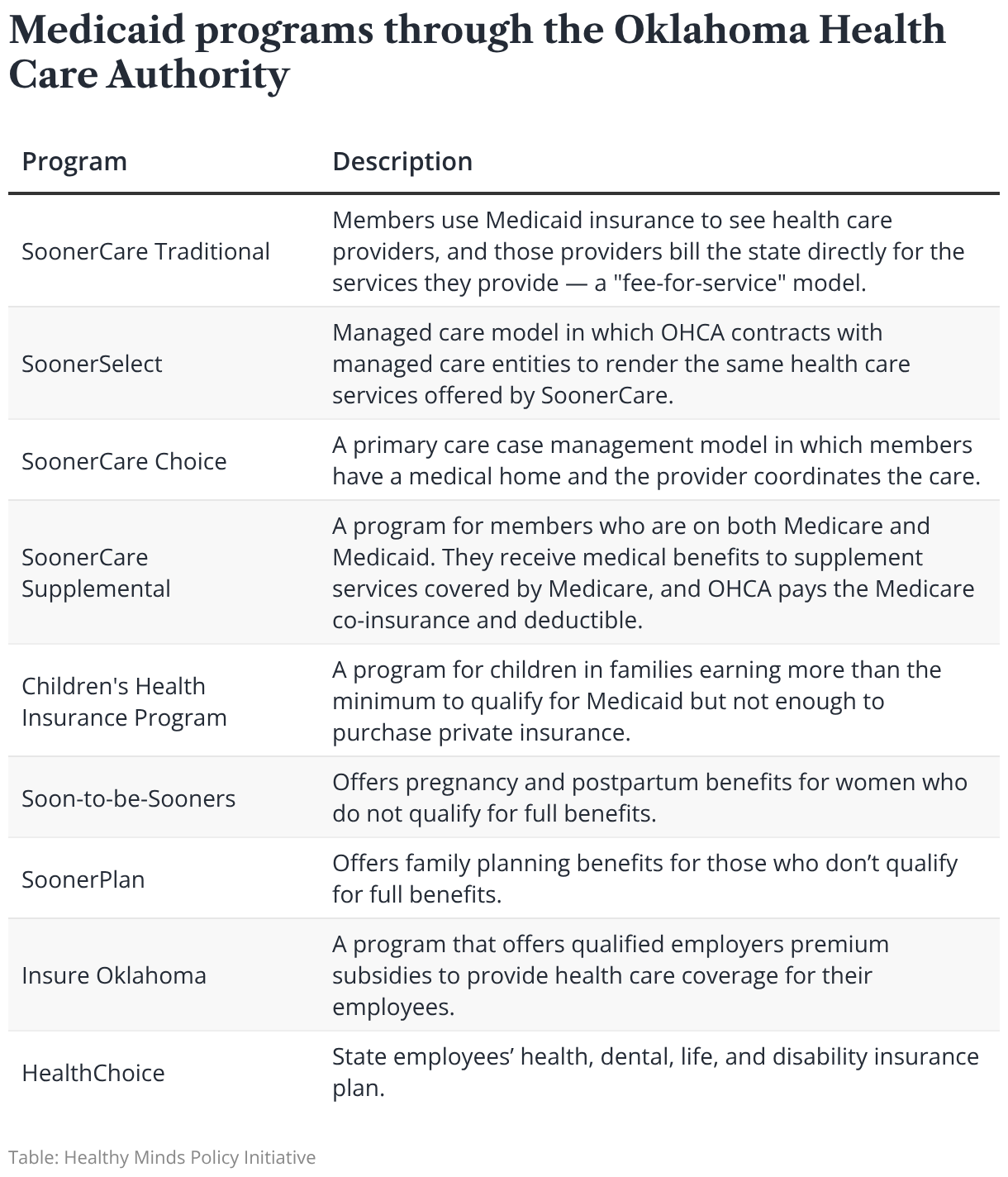
Today, OHCA manages a variety of programs, including SoonerCare Traditional, SoonerCare Choice, SoonerCare Supplemental, Soon-to-be-Sooners, SoonerPlan, Insure Oklahoma, Children’s Health Insurance Program, HealthChoice, and the newest managed care model, SoonerSelect, launched in 2024.
SoonerSelect: Managed care in Oklahoma
Under managed care, third-party insurance companies are hired by the state Medicaid authority to oversee the costs, quality, and utilization of health coverage for people on Medicaid. The insurance companies (referred to as contracted entities or managed care organizations) are paid a set amount for each Medicaid member they serve per month.
The majority of SoonerCare members are now in Oklahoma’s managed care program, SoonerSelect.
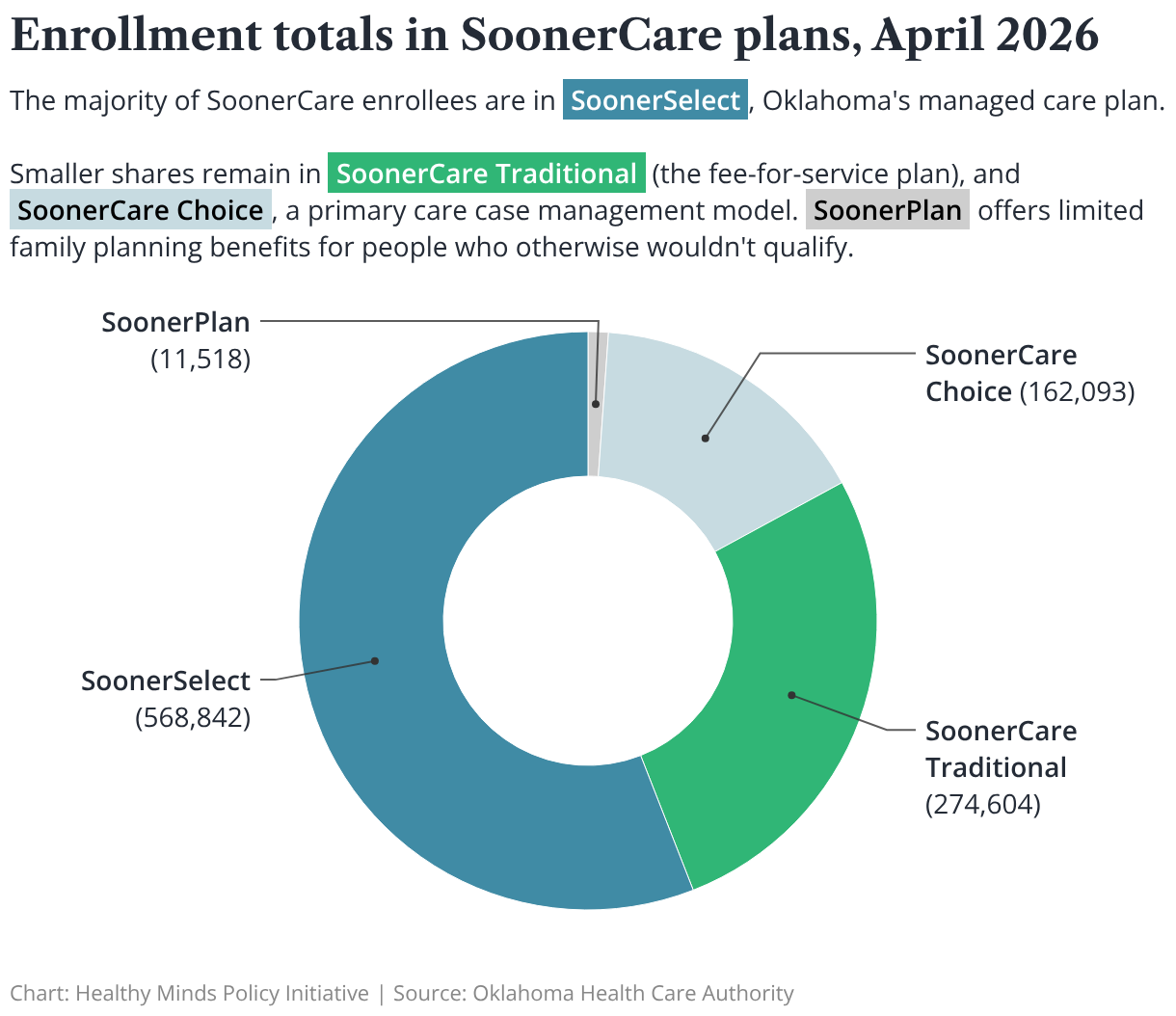
SoonerSelect manages the medical benefits for children, parent and caretaker relatives, pregnant women, and non-disabled adults ages 19 to 64.
Other eligibility groups are either excluded or are optional to enroll with a plan. For instance, the aged, blind, and disabled population is excluded from SoonerSelect, but continues to receive coverage through SoonerCare Traditional. (However, this group could be moved to managed care in the future.)
Each year, SoonerSelect members enroll in one of three available health plans. The plans coordinate services through the plan’s network of contracted providers and offer value-added benefits outside of Medicaid benefits that are aimed at supporting members’ overall wellness and addressing social determinants of health. This might include benefits liketemporary assistance with rent and utilities, or rewards for completing recommended doctor visits.
Under managed care, the state pays insurance companies for the members they cover, and the insurance companies (called contracted entities, or CEs, in Oklahoma) pay providers for the services they deliver to members.
To provide stability during the SoonerSelect transition, legislators introduced a minimum reimbursement level from contracted entities to providers, known as the “rate floor,” which protects providers from rate cuts. During the 2026 legislative session, lawmakers passed House Bill 3650 to preserve current provider rates until July 1, 2028.
Oklahoma's history with managed care
This is not the first time Oklahoma Medicaid has operated under a managed care model: in the early 1990s, lawmakers shifted the Medicaid program to OHCA (previously with Oklahoma Human Services) and directed it to move from a fee-for-service model to managed care through Senate Bill 76.
In 1995, the state received federal approval to launch SoonerCare Plus, a managed care model for urban areas, and SoonerCare Choice, a primary care case management model for rural areas.
But less than 10 years into the managed care model, several managed care organizations dropped out of SoonerCare Plus due to high costs after the state moved the aged, blind and disabled population into managed care. To compensate for higher costs, the managed care organizations sought an 18% increase in reimbursement; however, ongoing budget pressures prevented the state from meeting this demand. As a result, OHCA terminated SoonerCare Plus in 2004, and all members transitioned into SoonerCare Choice, which continues as Oklahoma’s primary care case management model.
While Oklahoma ended the traditional managed care model in 2004, managed care returned almost two decades later. In 2022, Oklahoma legislators enacted Senate Bill 1337, directing OHCA to reinstate managed care for both urban and rural areas.
Managed care contracted entities
Once OHCA received federal approval to reform its Medicaid delivery system, it entered into contracts with insurance companies to deliver health care services to members through SoonerSelect. Under these contracts, the insurance companies must ensure Medicaid members statewide receive the care they need and experience improved health outcomes.
In managed care, contracted entities take on the financial and operational risks of caring for the Medicaid population.
States adopt strategies to limit this risk for the insurance companies — for example, by making amendments to their per-member per-month payments, or through a strategy called the “risk corridor.” The risk corridor ensures that the state and the insurance company share in risk and benefits: for example, if a health plan spends more than projected, the state may share in the extra expenses. If a health plan spends less than projected, the state may require it to share those savings.
How Medicaid is funded
In 1965, the U.S. Congress enacted Medicaid under Title XIX of the Social Security Act as a state and federal partnership. The program has grown from a targeted health care program for low-income families receiving financial assistance to the nation’s critical safety net program for more than 75 million low-income Americans.
States must abide by federal requirements that set mandatory populations and service levels. In exchange, states receive federal dollars calculated by the Federal Medical Assistance Percentage, or FMAP.
The federal and state government each pay a percentage of the cost of services. Currently, the federal government pays 66% of the Oklahoma's Medicaid costs, while the state picks up the difference. For Medicaid expansion adults, the federal government pays 90% of the costs.
The FMAP formula calculates the federal share of Medicaid costs, and the remaining percentage is funded by the state. States with lower earnings get a higher FMAP; states with higher earnings get a lower rate. The rate can vary year to year based on state income changes, formula adjustments, or temporary increases due to public health emergencies. The minimum state match is 50%.
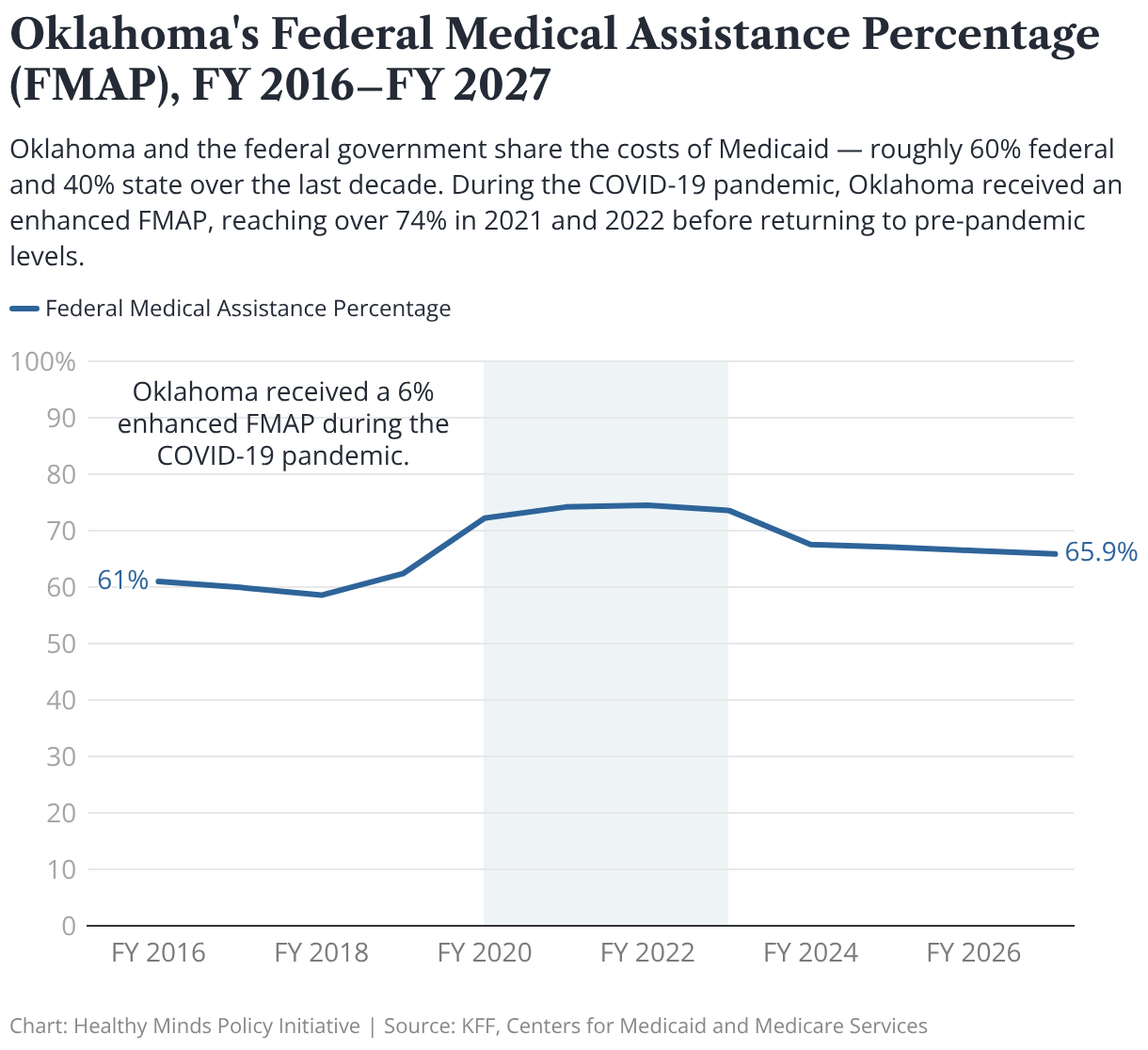
Although the rate is generally variable, certain administrative activities (e.g., prescription drug monitoring programs), services (e.g., family planning) and populations (e.g., expansion adults), qualify for higher federal matching rates. The federal government also supports states with a fixed 50% FMAP for administrative related expenses such as outreach and training.
The federal match rate for the expansion population was set by Congress in 2010. However, federal lawmakers have recently proposed replacing the 90% federal match for this population with a standard formula-based federal match. Analysts have warned that ending the enhanced federal match would significantly increase costs for the state, potentially leading the state to roll back Medicaid expansion, and leaving thousands of Oklahomans uninsured.
Oklahoma’s share of the costs for the state’s Medicaid program is comprised of a combination of ten funding streams, including:
- funds allocated by the Legislature
- fees from hospitals and nursing homes
- rebates from pharmaceutical companies
- tobacco taxes
- payments or reimbursements from medical providers and state agencies (including the Oklahoma Department of Mental Health and Substance Abuse Services, Oklahoma Human Services, the Oklahoma State Department of Health, and the Oklahoma Office of Juvenile Affairs)
Medicaid state plans
States formalize their partnerships with the federal government through a written plan submitted to CMS, called a Medicaid state plan. The plan outlines how the state will run its Medicaid program and describes eligibility groups, covered services, provider standards, and payment methodologies.
States can update their state plans as needed by submitting a state plan amendment to CMS. States often do this to bring the state into compliance with federal or state law, remove obsolete language, fix errors, add new providers, optional benefits, or eligibility groups.
For example, in 2022, OHCA amended its state plan to support the implementation of Certified Community Behavioral Health Clinics (CCBHCs) by including CCBHCs as Medicaid providers and setting up a reimbursement methodology for their services.
Medicaid waivers
A Medicaid waiver is a special authority found in the Social Security Act that allows the Secretary of Health and Human Services to approve a state's proposal to test new services or expand eligibility to groups that would not otherwise meet Medicaid requirements.
Oklahoma currently has nine Medicaid waivers in place that allow innovative health care approaches and expand coverage to groups who would otherwise not be eligible.
There are three types of waivers:
- 1115 waivers allow states to try new approaches to health care beyond what is normally permitted under federal law;
- 1915(c) waivers permit states to offer home and community services to keep individuals at home rather than in an institution;
- 1915(b) waivers allow states to limit provider choice to curb costs, improve program effectiveness, and implement managed care.
Oklahoma has two 1115 waivers: the Institution for Mental Diseases (IMD) 1115 waiver, which provides mental health and substance use treatment to adults in certain psychiatric facilities, and the SoonerCare Choice and Insure Oklahoma waivers, which assign members a primary care provider that coordinates their care and facilitates access to affordable health care coverage for low-income working families and small businesses.
The state also has one 1915(b) waiver for the implementation of SoonerSelect, and six 1915(c) home- and community-based waivers that provide a range of services not typically covered by Medicaid for medically frail seniors and individuals with physical and intellectual disabilities.
Waivers can be renewed as long as they continue to meet federal requirements, including budget neutrality. This means that the waiver will not cost the federal government more if the waiver had not been approved.
However, beginning in 2027, federal changes in H.R. 1 (2025) will require that new waiver requests or renewals include approval from CMS’s chief actuary that the waiver will not increase federal spending.
Currently, states submit projections based on their own data to model program costs with and without a waiver. For Oklahoma’s IMD waiver, the state submitted annual projections demonstrating that reimbursing providers in IMD settings will not cost more than the status quo.

