Data snapshot: 2025 behavioral health provider data shows heavily part-time workforce
Like states across the nation, Oklahoma faces a critical shortage of behavioral health providers: a majority of Oklahoma counties are designated as mental health professional shortage areas.
New data for 2025 further illustrates that access to behavioral health providers is uneven across the state — and reveals that relatively few licensed providers see clients full-time.
Until now, Oklahoma policymakers’ understanding of the behavioral health workforce was only based on head counts: simple tallies of how many providers were licensed to practice in the state. Since lawmakers passed House Bill 3330 in 2024, licensure boards have begun to collect data that offers a clearer picture of providers’ actual capacity by asking about their time spent with clients.
Though only one board reported complete data for 2025, these new results showed a heavily part-time workforce, which means head counts far overstate Oklahoma’s actual workforce capacity.
These findings offer important context around urgent behavioral health workforce challenges: providers face increased service demands and low reimbursement rates, and many leave the industry because of burnout and attrition. Rural communities especially struggle to recruit providers. Investigating, standardizing, and improving workforce data are critical steps toward solving these challenges and strengthening the state’s workforce capacity.
In this data snapshot, we review results from the first full year of data collection under HB 3330 and discuss how those findings can inform strategies to strengthen workforce capacity in the state.
Key takeaways:
- Raw head counts of behavioral health providers far overestimate Oklahoma’s workforce capacity.
- Less than a third of providers report 21 or more client-facing hours per week, which we estimate as practicing full-time. About 20% of licensed providers reported no service delivery at all.
- HB 3330 requires boards that license behavioral health providers to collect information from licensees that give better insight into the workforce’s actual capacity. But only one board provided data for 2025, which only represents about 39% of the estimated 14,000 providers licensed in Oklahoma. Other boards either did not collect the information this cycle, provided incomplete data, or could not convert the data into a digital format.
New findings: A heavily part-time workforce
HB 3330, by Rep. Cynthia Roe (R-Lindsay) and Sen. Paul Rosino (R-Oklahoma City), was passed in 2024. The law requires board administrators to collect additional information during a provider’s annual license renewal, like how much time they spend face-to-face with clients per week.
The Oklahoma State Board of Behavioral Health Licensure — which handles licenses for licensed professional counselors, licensed marriage and family therapists, and licensed behavioral practitioners — collected data during license renewals in 2025.
In response to the board’s question about client contact hours, providers fell into one of three broad groups:
- Providers not currently providing direct services
- Providers delivering services at a part-time level
- Providers delivering services at a level estimated to be full-time
In data reported by the Board of Behavioral Health Licensure, nearly half of licensees (49%) reported providing between 1 and 20 client hours weekly. This indicates that the licensed provider population is a heavily part-time clinical workforce. Typically, a full-time therapist would spend about 25 to 30 hours per week with clients; the remainder of clinical time is spent charting, treatment planning, coordinating, consulting, or on other administrative work.
About 31% of providers report 21+ face-to-face client contact hours per week (which we estimated as full-time), and about 20% report no service delivery at all. “Face-to-face" includes telemental health services.
Further, of the 5,404 providers for whom there was data from the Board of Behavioral Health Licensure, 346 providers resided in other states or international locations. About a quarter of them (91) lived in states that bordered Oklahoma.
Previously, mental health workforce reporting was limited to head counts only, and this assumed each person counted was employed full time.
This new data reveals important nuance that was previously unavailable, demonstrating that a state's provider head count does not necessarily equal its workforce capacity.
Related: The state of Oklahoma's behavioral health workforce
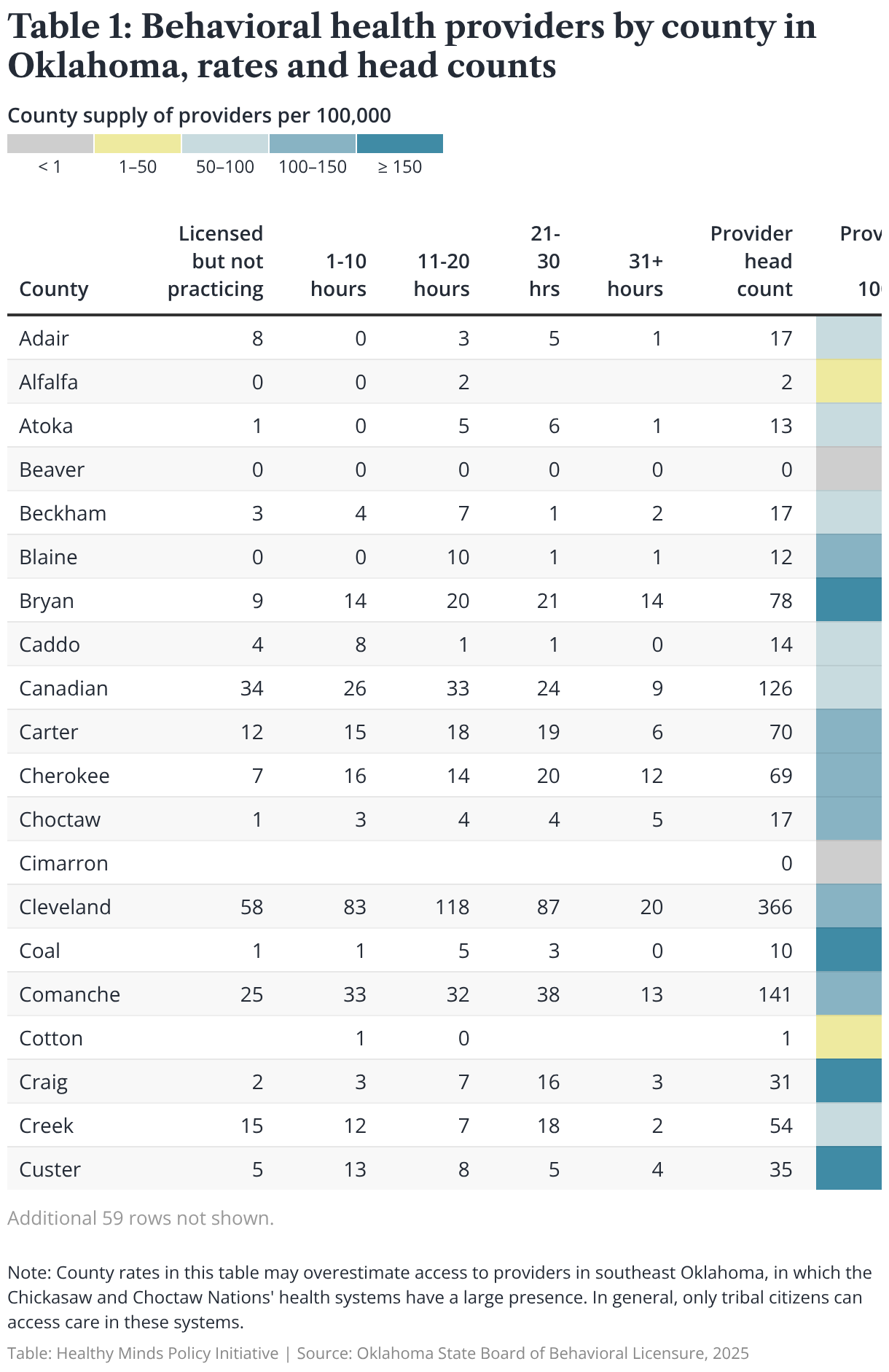
Figures 1 and 2 show the difference in Oklahoma’s provider workforce by head count alone versus an estimate of full-time equivalent providers that takes into account licensees’ time spent with clients. See the appendix for provider data in table format.
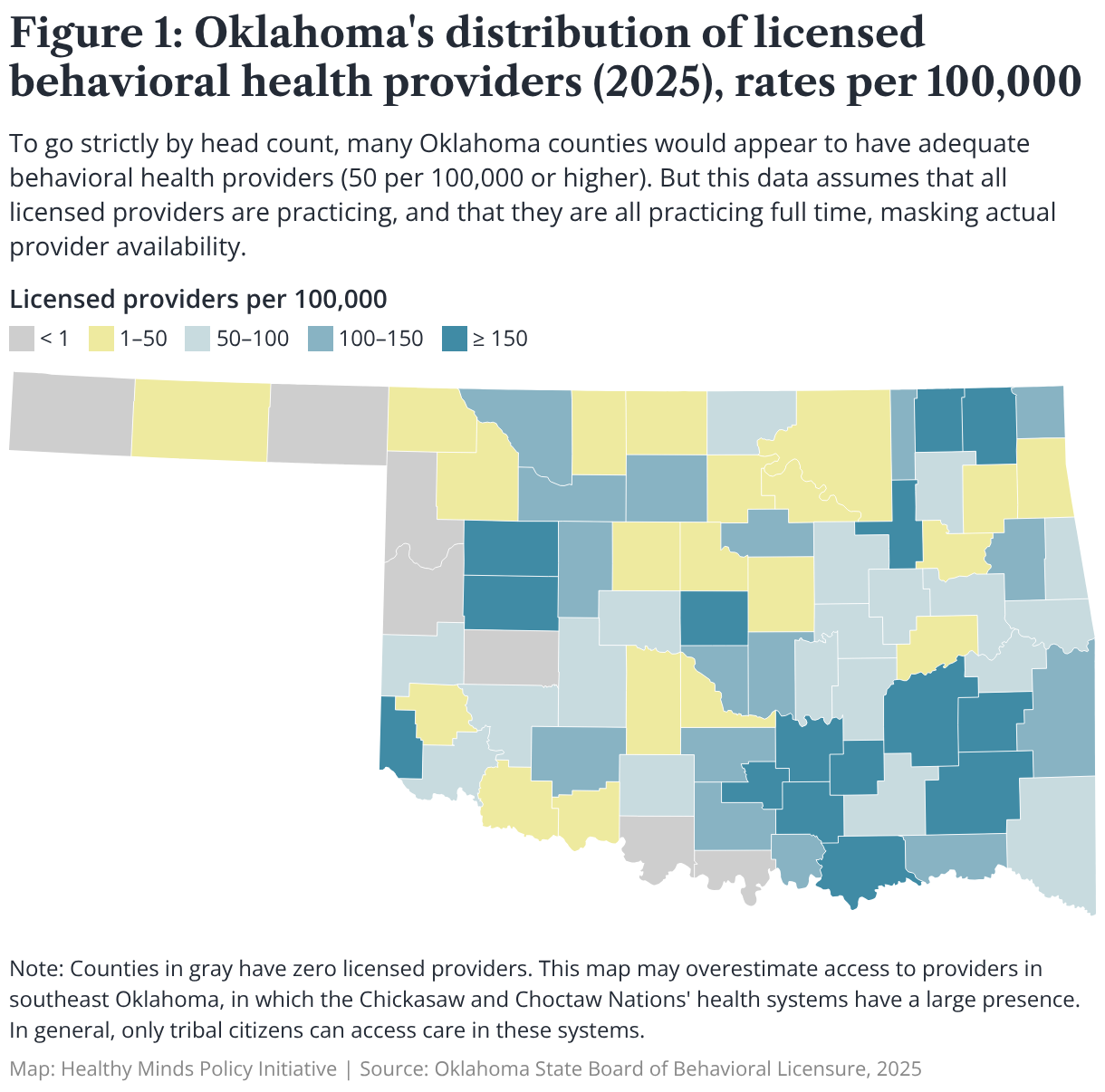
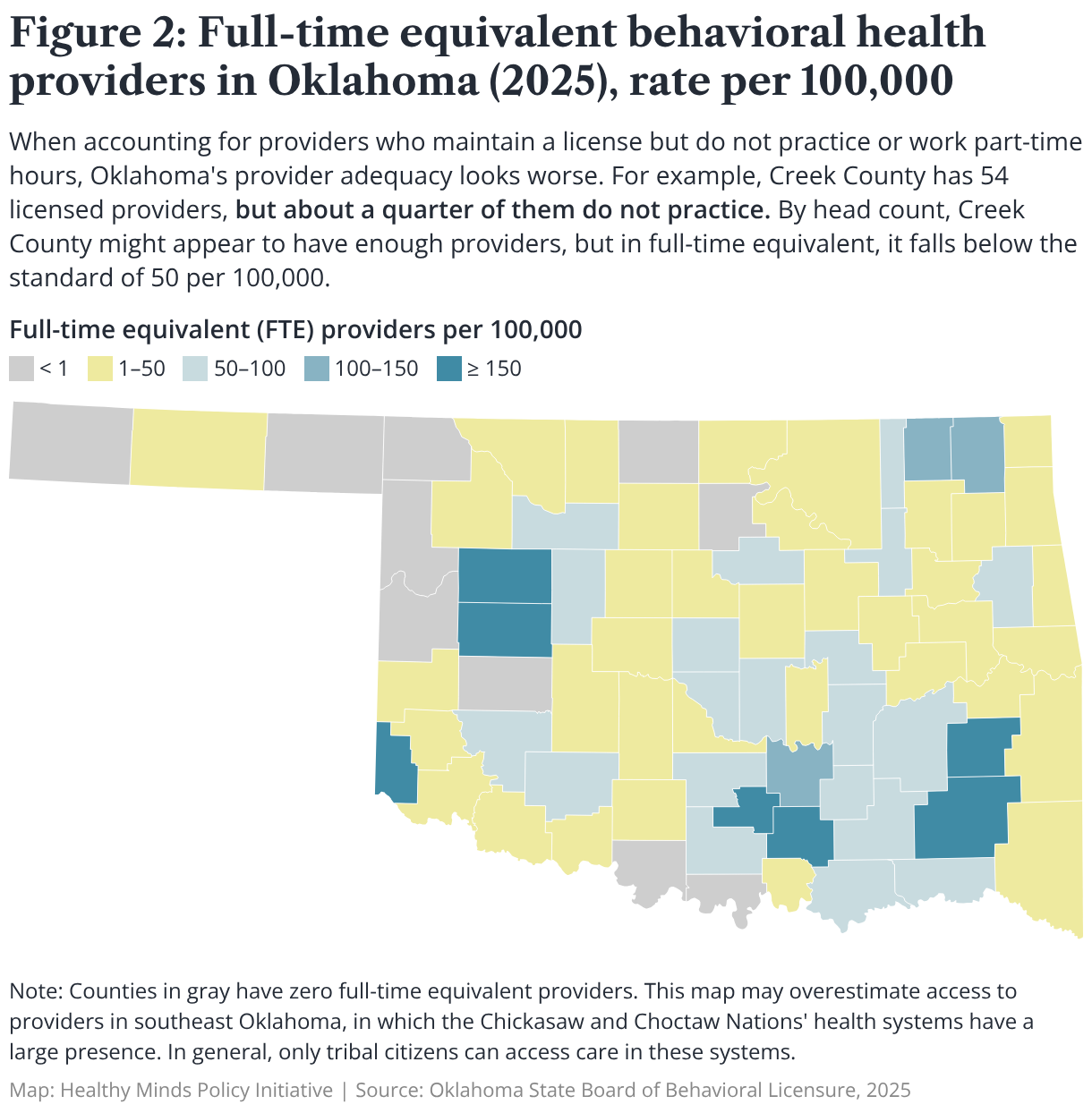
For each map, we compare counties’ workforce supply and capacity against the recommended behavioral health workforce standard of 50 providers per 100,000 population. This standard is used in some workforce reporting agencies, such as the Health Resources and Services Administration (HRSA). Alternative approaches might include calculations for each provider type, and whether an area or community had unusually high needs.
When considering all providers by head count, 65% of counties in Oklahoma met this standard. However, this proportion declined substantially when we excluded non-practicing providers, with only 39% of counties meeting the standard. When we further limited the analysis to full-time providers only, just 19.5% of counties met the recommended threshold.
To add context, the area in southeast Oklahoma showing where needs are met is largely represented by counties in the Chickasaw and Choctaw tribal territories. Public information demonstrates that these two tribes prioritize their health care systems and emphasize behavioral health treatment. However, those who receive services within tribal jurisdictions must be qualified by Indian Health Service or local tribal criteria, which means services are not usually available to the public at-large.
Implications for Oklahoma and next steps
In this analysis, we focus on some of the current supply side dynamics of Oklahoma’s behavioral health workforce, though certainly not the full range.
For a complete picture of Oklahoma’s workforce supply, we would need to consider — in addition to a complete view of clinicians’ weekly hours spent with clients across provider types — recruitment to training programs, distribution of providers across the state after graduation, and retention of providers once placed.
To that end, the data we analyze in this report offers important context, but it is only a fraction of the data we expect will be collected in future years.
As data collection by licensure boards under HB 3330 becomes more dependable over time, Oklahoma will be able to use these insights to improve state-level strategies to address workforce supply challenges.
Oklahoma is also positioned to help strengthen national mental health workforce planning through more advanced data collection.
Several federal agencies are involved in estimating the full scope of mental health workforce needs with scientists who perform sophisticated data modeling to generate targeted numbers for each profession. The Health Resources and Services Administration (HRSA) publishes these approaches with explanations as to how they work, as well as recommendations for improvement, with each phase of analysis.
With future insights from HB 3330, Oklahoma can pass on results to HRSA’s workforce projection efforts, which could inform how the agency approaches analyzing full- versus part-time workers and assist stakeholders in future workforce planning.
Many partners have a role to play in strengthening the behavioral health workforce: university training programs, health care employers, licensure boards, state agencies such as the Health Care Workforce Training Commission, the Oklahoma Office of Rural Health, and others.
Ultimately, better data collection and insights will help policymakers and other stakeholders find solutions that lead to Oklahomans having better access to care through a strong and supported behavioral health workforce. The more complete a picture we have of Oklahoma’s workforce and its capacity, the better these stakeholders can respond and adapt.
Data limitations
The data we analyzed in this piece was only collected from one licensing board, the Oklahoma State Board of Behavioral Health Licensure. This represents 5,404 of an estimated 14,000 total licensed providers in Oklahoma.
The Board of Behavioral Health Licensure oversees licensing for licensed professional counselors, licensed marriage and family therapists, and licensed behavioral practitioners. The board’s data set was not broken down by license, so it was not possible to identify findings specific to licensed professional counselors, for example.
Other types of licensed behavioral health clinicians — such as licensed clinical social workers, psychologists, and psychiatrists — were not included in this analysis because data was unavailable from the boards that license these groups.
Of the providers in this data set, several indicated in a notes section that they provided exclusively telemental health services to all communities within Oklahoma borders. Therefore, we excluded those 20 providers from our map, because we could not specify where they delivered services.
Other licensure boards sent incomplete files, reported issues with converting data to an easily accessible digital format, or did not collect the information for this cycle but plan to in the future.
Appendix: