
Intensive community-based services and Assertive Community Treatment in Oklahoma
People with serious mental illness or substance use challenges often need more care than weekly visits with a therapist but less than inpatient hospitalization to manage their health and work toward recovery.
Intensive community-based services offer this middle ground with more frequent, coordinated care, often delivered by a team of providers and support professionals. In general, this type of care doesn't happen in a doctor’s office or from a therapist’s couch — the team goes where the person lives or spends time in the community.
In Oklahoma, access to intensive community-based services is lacking. When people can’t access this level of care, they often end up in costly inpatient settings, emergency rooms, or jails.
Program of Assertive Community Treatment, or PACT, is a longstanding, evidence-based model for delivering intensive community-based services. In this primer, we cover the basics of PACT and one of its modifications, Forensic Assertive Community Treatment.
What are Programs of Assertive Community Treatment?
Program of Assertive Community Treatment is the most well-known and researched model of intensive community-based care for individuals with serious mental illness, especially for people with diagnoses such as schizophrenia or bipolar disorder.
To be eligible for PACT in Oklahoma, people must meet specific criteria:
- Have a primary diagnosis of schizophrenia or another psychotic disorder
- Have at least four psychiatric hospitalizations (or spend over 30 days in the hospital) over the last two years
- Be on the Oklahoma Department of Mental Health and Substance Abuse Services’ “most in need” list, which indicates they have had multiple encounters with the behavioral health crisis system
Related: Programs of Assertive Community Treatment: Oklahoma’s unmet needs and opportunities to expand intensive services
People served by a PACT team are seen anywhere from three times a week to daily, depending on their level of need.
PACT teams are available 24 hours a day, seven days a week, 365 days a year, and are the primary point of contact if the person receiving services experiences a crisis.
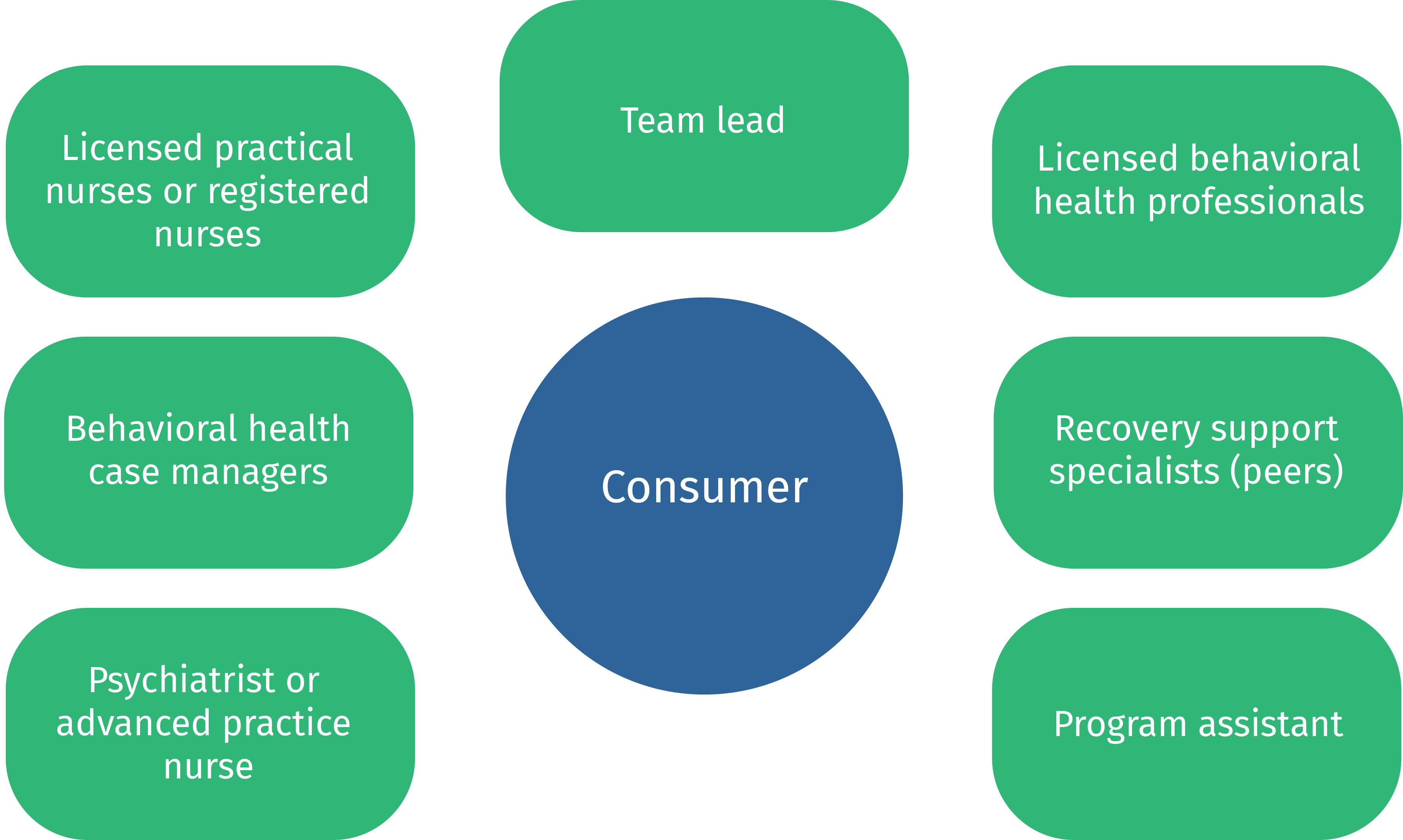
At minimum, a standard PACT team has:
- One full-time team lead, a licensed behavioral health professional who acts as an administrative and clinical supervisor
- One psychiatrist (or advanced practice nurse with certification in a psychiatric or mental health specialty who has prescribing privileges)
- Two full-time nurses, both with mental health or psychiatric care experience
- One full-time licensed behavioral health professional (or candidate for licensure)
- Two full-time behavioral health case managers
- One full-time or two part-time recovery support specialists (peers)
- One full-time program assistant
PACT teams also must have one staff member certified as a substance use treatment specialist and one as an employment specialist; any team member can hold the certification to meet the requirement.
Positions on a standard PACT team
What is Forensic Assertive Community Treatment?
Forensic Assertive Community Treatment (FACT) is a variation of PACT. The models work similarly, but FACT focuses on people with serious mental illness who have had frequent encounters with the criminal justice system. FACT teams’ goals are to prevent people from being arrested, incarcerated, or hospitalized by meeting their behavioral health and social support needs.
The team structure is also similar to PACT’s, but FACT has a few distinctions:
- One staff member has a criminal justice background (such as a probation officer)
- One staff member is a peer with lived experience in the criminal justice and mental health systems
- Eligibility requires a history of involvement with the criminal justice system
People may connect with a FACT team through various means, including participation in mental health court or after being determined “not guilty by reason of mental illness” in a criminal court proceeding.
Sometimes, people could be eligible for both PACT and FACT. In those cases, FACT is the better choice, since those teams can provide additional services to address risk factors specific to the criminal justice system.
The evidence for PACT and FACT
PACT creates cost savings for communities by diverting people from hospitals or jails and into proper behavioral health treatment settings.
For example, in Healthy Minds’ 2024 analysis, we found that it costs about $1,000 to $1,400 per month to serve one person with a PACT team. Incarcerating someone for the same amount of time in Oklahoma would cost $1,745 to $3,290, and a hospital stay for a month would cost more than $29,000.
For FACT, recent controlled research found a 1.5x return on investment, due to reduced use of inpatient hospitals, ERs, and jails.
Not only do PACT and FACT cost taxpayers less than treating people in inappropriate settings, but the model also yields better outcomes for the people receiving services.
The closer these teams adhere to their respective models, the better outcomes they produce, including reduced hospital use, reduced costs, improved substance use outcomes, and increased functioning and quality of life for the people they serve.
PACT has also been shown to reduce homelessness among people with serious mental illness.
PACT and FACT in Oklahoma
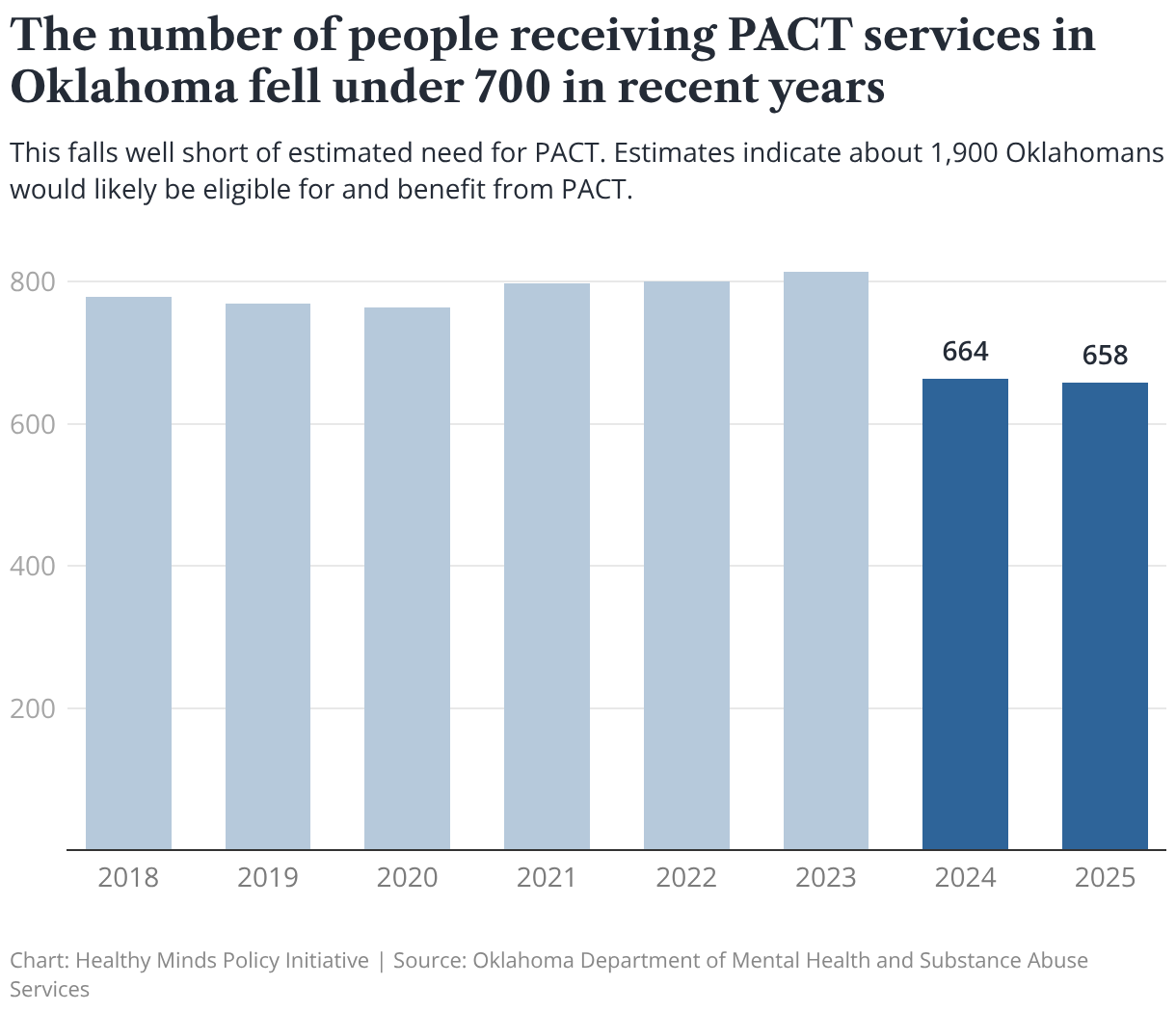
In fiscal year 2025, fewer than 700 people received PACT services statewide, according to data from the Oklahoma Department of Mental Health and Substance Abuse Services (ODMHSAS).
Researchers capture how many people are likely to be eligible for a PACT team in two ways — either by calculating 0.06% of the total adult population, or 2.23% of the population with serious mental illness. Based on those calculations (using 2024 population data from the American Community Survey and ODMHSAS’ FY 2025 data on consumers with serious mental illness), between 1,879 and 2,053 Oklahoma adults are likely eligible for PACT.
By either measure, Oklahoma does not meet the need for this service.
Estimated need for FACT teams is calculated similarly: either 0.05% of the total adult population or 1.93% of the adult population with serious mental illness. By these calculations, between roughly 1,500 to 1,800 adults in Oklahoma could be eligible for and benefit from FACT.
To this point, there are no FACT teams in Oklahoma. But Tulsa is soon to have the state’s first: the city has committed funding to launch a FACT unit operated by Family and Children’s Services, a Certified Community Behavioral Health Clinic.
This primer was adapted from Healthy Minds’ 2024 publication, “Programs of Assertive Community Treatment: Oklahoma’s unmet needs and opportunities to expand intensive services.”

